Short answer
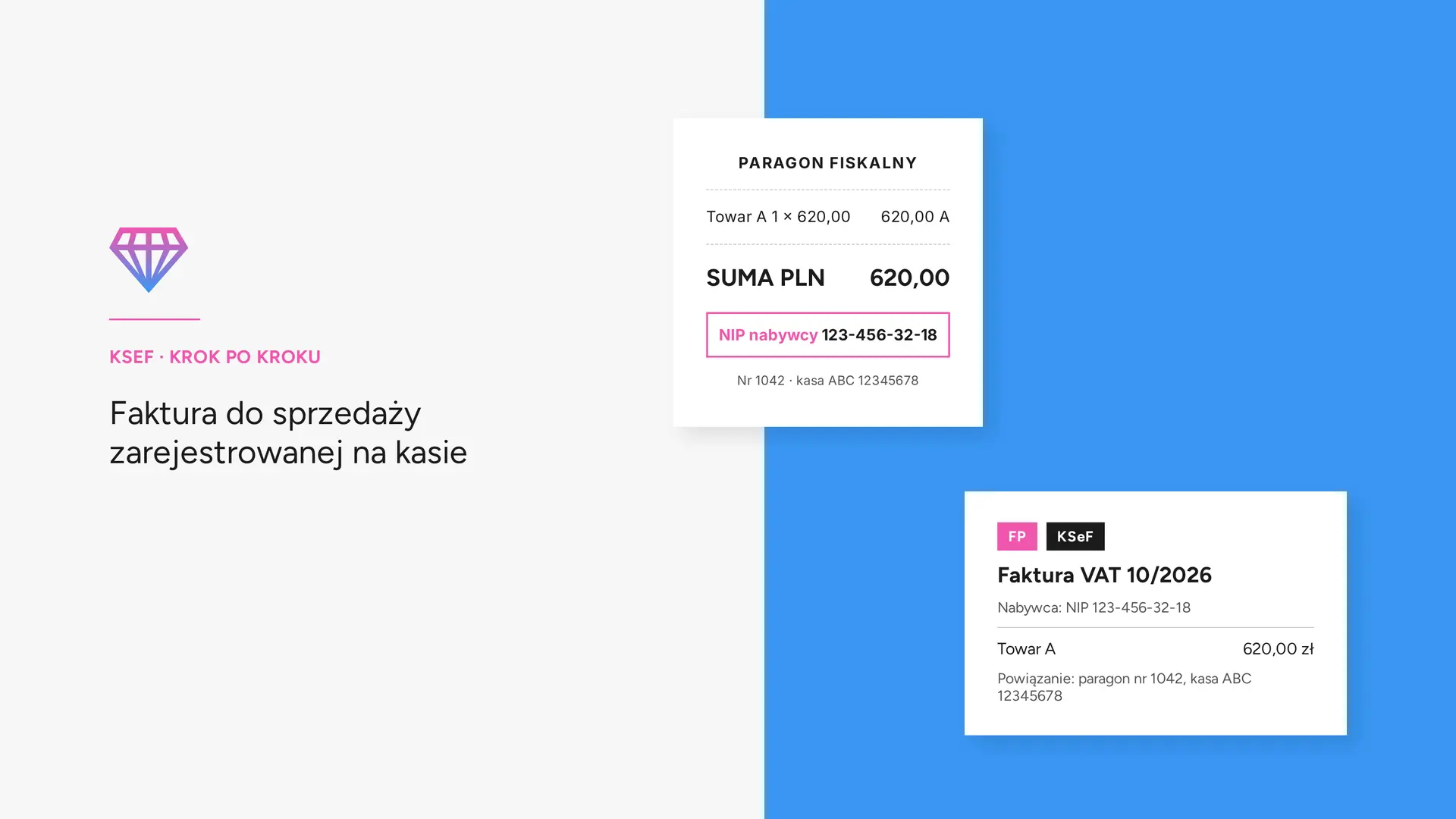
An invoice for a receipt (faktura do paragonu) is an invoice for a sale that has already been registered on a fiscal cash register. For a business, it can be issued only if the buyer's NIP is on the receipt. The seller must keep the link between the invoice and the receipt — in their records they keep the receipt number and the cash register's unique number together with the invoice identification data, or the paper receipt. An invoice for a sale from the cash register is recorded with the FP marker. An invoice for a business goes to KSeF (from 2027, as a rule, always); an invoice for a private individual — optionally.
A customer pays at the till, gets a receipt and, a moment later — or two weeks later — comes back for an invoice. Every shop knows this scenario. With KSeF, the place where this invoice is created changes, along with a few details that are easy to trip over. Below we walk through the whole process.
What a receipt with NIP is and when it works as an invoice on its own is explained in Receipt with NIP in Poland: the PLN 450 limit.
When is an invoice for a receipt issued
| Situation | Invoice for the receipt | Notes |
|---|---|---|
| Business, NIP on receipt, up to PLN 450 (2026) | not needed | the receipt with NIP already is a simplified invoice — a second invoice is a duplicate |
| Business, NIP on receipt, above PLN 450 (2026) | yes — an invoice is required | the receipt is not a simplified invoice; if the sale was first registered on the cash register, an invoice for that sale is issued (in KSeF, if the seller is covered by the obligation) |
| Business, NIP on receipt, any amount (from 2027) | yes — an invoice is required | a receipt with NIP is no longer an invoice; the invoice is, as a rule, issued in KSeF |
| Business, no NIP on receipt | no | prohibited under Art. 106b(5) of the VAT Act |
| Private individual | yes, on request | KSeF optional; name and address are enough |
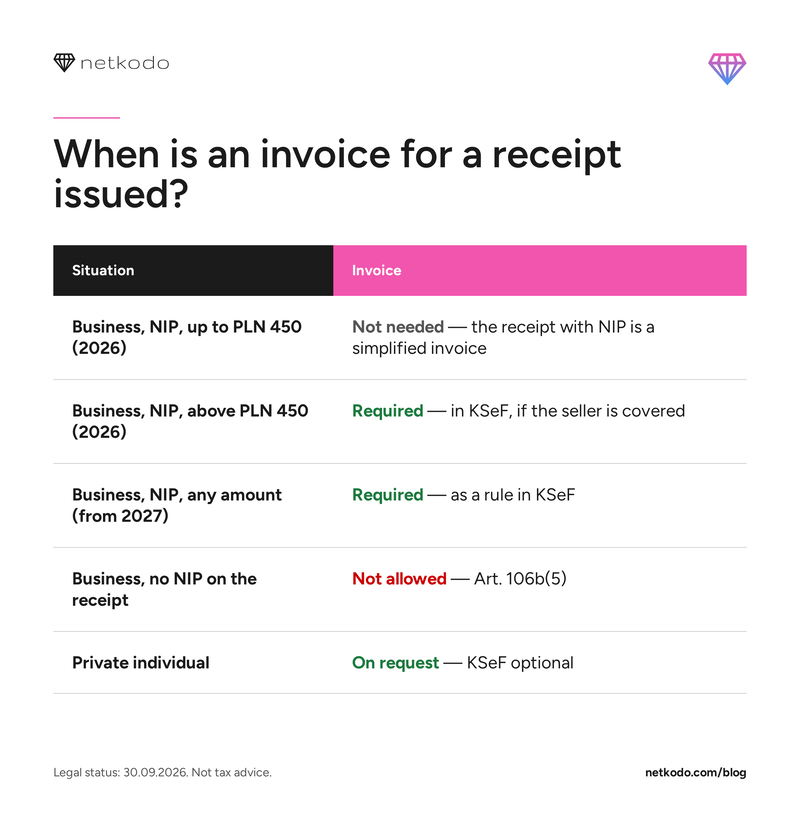
For a sale to a business, the obligation to issue an invoice comes directly from the Act (Art. 106b(1)) — it does not depend on whether the customer asks for it. Invoices "on request" apply where the seller had no original obligation to issue one, mainly consumer sales.
Deadlines
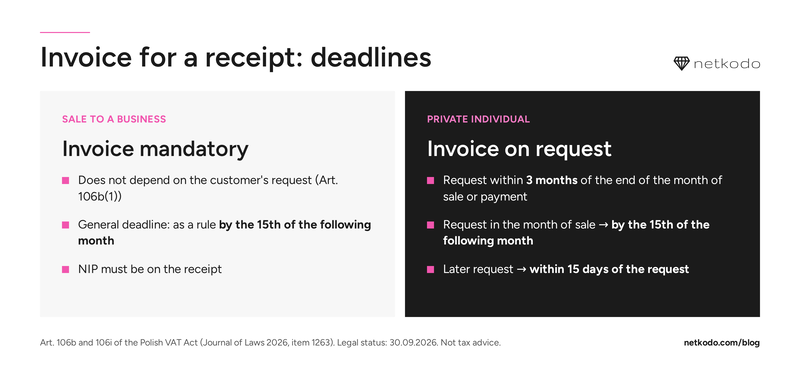
Sale to a business. If the sale is made to a business and an invoice is required, the general invoicing deadlines apply — as a rule, the invoice is issued no later than the 15th day of the month following the month of sale.
Invoice on request, e.g. for a consumer. The buyer can request it within 3 months from the end of the month in which the goods were delivered, the service was performed or payment was received. If the request is made in the month of sale, the invoice is issued within the general deadline. If later — no later than the 15th day from the request (Art. 106i).
Example for a consumer: purchase on 10 October, invoice requested on 28 October → invoice by 15 November at the latest. Requested on 5 December → invoice by 20 December at the latest.
What the invoice must contain and what to keep in your records
In addition to the standard invoice elements:
- Link to the receipt in your records. The seller keeps the document number and the cash register's unique number together with the invoice identification data, or the paper receipt (Art. 106h(1)). There is no general requirement for these numbers to appear on the invoice itself.
- The FP marker. An invoice for a sale previously registered on a cash register is recorded in JPK_VAT as FP. The FA(3) structure also provides an FP marker. Such an invoice is for record-keeping only: it does not increase the value of sales or output VAT, because the sale is already in the cash register report (Art. 109(3d)).
- Buyer data:
- business: NIP and — on a standard invoice — name and address. On a simplified UPR invoice, the buyer data may be narrower,
- private individual: name and address. No NIP or PESEL (national ID number) is needed.
- Data for the same sale. The invoice must document the sale registered on the receipt — the same goods, VAT rates and amounts.
Step by step: invoice for a receipt in KSeF
- Check the receipt and the buyer's status. If the invoice is for a business, check that the receipt shows the buyer's NIP. If it is an invoice on a consumer's request, also check that the request was made within the statutory 3 months.
- Check the amount (in 2026). If the receipt with NIP is for up to PLN 450, it already is a simplified invoice — do not issue a second one.
- Issue the invoice in software connected to KSeF. Most programs have a dedicated "invoice for a receipt" option. In Fakturownia, for example, the invoice is created from the receipt saved in the system, so the sale data carries over automatically.
- Keep the link to the receipt. In your records, keep the document number and the cash register's unique number together with the invoice identification data, or the paper receipt.
- Send to KSeF. The invoice gets a KSeF number. The business receives it in KSeF — directly or through its accounting software.
- Private individual: you can send the invoice to KSeF voluntarily or issue it outside KSeF and hand it over as a PDF or printout.
- Records: the accountant records the invoice in JPK with the FP marker.
In the free KSeF Taxpayer Application you can issue an invoice for a receipt manually — it has the field "FP – invoice referred to in Art. 109(3d) of the Act". Ticking FP does not, however, release the seller from keeping the link between the invoice and the receipt in their records. The application also does not support simplified invoices (UPR), and with several invoices a day, manual retyping quickly becomes a problem.
What changes from 1 January 2027
- A receipt with NIP does not replace an invoice — including for amounts up to PLN 450. If the sale is made to a business and is subject to invoicing, the proper invoice is, as a rule, issued in KSeF.
- Invoices are no longer issued on cash registers.
- There will be more invoices for cash register sales — in shops with many business customers, this can mean dozens of documents a day. Manual invoicing stops making sense.
The full list of changes and a checklist for shops are in Receipt with NIP and KSeF from 2027.
Let's talk about how your shop will issue invoices from January
Book 20 minutesMost common mistakes with invoices for receipts
- An invoice for a business for a receipt without a NIP. For issuing an invoice to a taxpayer in breach of this rule, the tax authority may impose an additional tax liability equal to 100% of the VAT shown on the invoice (Art. 106b(6)). The NIP must be on the receipt from the start.
- A second invoice for a receipt with NIP up to PLN 450 (in 2026). The receipt already is an invoice — you create a duplicate and risk double VAT.
- No FP marker in JPK. This may cause the sales value and output VAT to be counted again, even though the transaction was already settled in the cash register report.
- No link to the receipt in your records. Without the document number and the cash register's unique number (or the paper receipt), the invoice cannot be matched to the cash register sale.
- Items different from the receipt. The invoice must document the same sale.
- Treating a business invoice as an invoice "on request". For a B2B sale, the invoice is mandatory within the general deadline, whether or not the customer asks for it.
A receipt without a NIP should be distinguished from an obvious mistake in a NIP already printed on the receipt, which in certain cases can be corrected. The Act also provides special penalty rules, e.g. for individuals liable under the Fiscal Penal Code for the same act and for taxi services.
How it works in Shopify POS with Netkodo Fiscal Gateway
In Shopify POS with Netkodo Fiscal Gateway, the sales assistant handles the business invoice on the iPad, during the sale:
- The customer says they are buying for a business. The sales assistant enters the NIP in Shopify POS before closing the sale.
- Fiscal Gateway prints the receipt with NIP on a Posnet, Novitus or Elzab printer.
- The invoice is created in the integrated invoicing software (Fakturownia, wFirma or inFakt), linked to the sale and — once the KSeF integration is configured — sent to KSeF.
Fiscal Gateway saves the document number or receipt number (depending on the printer protocol) and the printer’s unique number with the Shopify order. A communication error with the printer may prevent the number from being retrieved and saved.
See how Fiscal Gateway works →
FAQ
Can an invoice be issued for every receipt?
For a private individual — yes, on request within the statutory deadline. For a business — only if the buyer's NIP is on the receipt.
Is an invoice for a receipt mandatory for a business?
Yes. For a sale to a business, the obligation to issue an invoice comes from the Act, not from the customer's request. In 2026 the exception is a receipt with NIP up to PLN 450, which is itself a simplified invoice.
Does an invoice for a receipt have to be in KSeF?
For a business — yes, if the seller is covered by the KSeF obligation (from 2027, as a rule, always). For a private individual — no, KSeF is optional.
How much time is there to issue an invoice for a receipt?
It depends on the buyer. For a B2B sale where an invoice is mandatory, the general invoicing deadlines apply — as a rule, by the 15th day of the following month. For an invoice on request, e.g. for a consumer, the request must be made within 3 months from the end of the month of sale or payment. If it is made after the month of sale, the seller has up to 15 days from the request to issue the document.
What is an FP invoice?
It is an invoice for a sale previously registered on a cash register, recorded in JPK_VAT with the FP marker. It does not increase the sales value or output VAT, because the sale is already in the cash register report. The FA(3) structure in KSeF also has an FP marker.
Can an invoice be issued for a receipt without a NIP?
For a private individual — yes. For a business — no. For issuing an invoice to a taxpayer for a receipt without a NIP, the authority may impose an additional liability of 100% of the VAT on the invoice.
Does an invoice for a private individual require a PESEL number?
No. Name and address are enough.
Is an invoice issued for a receipt with NIP up to PLN 450?
In 2026, no — such a receipt already is a simplified invoice. From 2027, yes, because a receipt with NIP stops being an invoice.
Does the receipt number have to be on the invoice?
There is no general requirement for the receipt number and the cash register's unique number to appear on the invoice itself. The seller must, however, keep the link between the invoice and the receipt in their records — through the document number and the cash register's unique number together with the invoice identification data, or by keeping the paper receipt.
This article is for information only and is not tax advice. Legal status as of 30 September 2026. Basis: Polish VAT Act of 11 March 2004 (consolidated text: Journal of Laws 2026, item 1263), Art. 106b, 106h, 106i, 109(3d), 145n; Ministry of Finance KSeF materials. For your specific situation, consult an accountant or tax adviser.
Any questions?
We help Polish shops sell on Shopify and Shopify POS in line with Polish regulations — from fiscal printers to KSeF.




