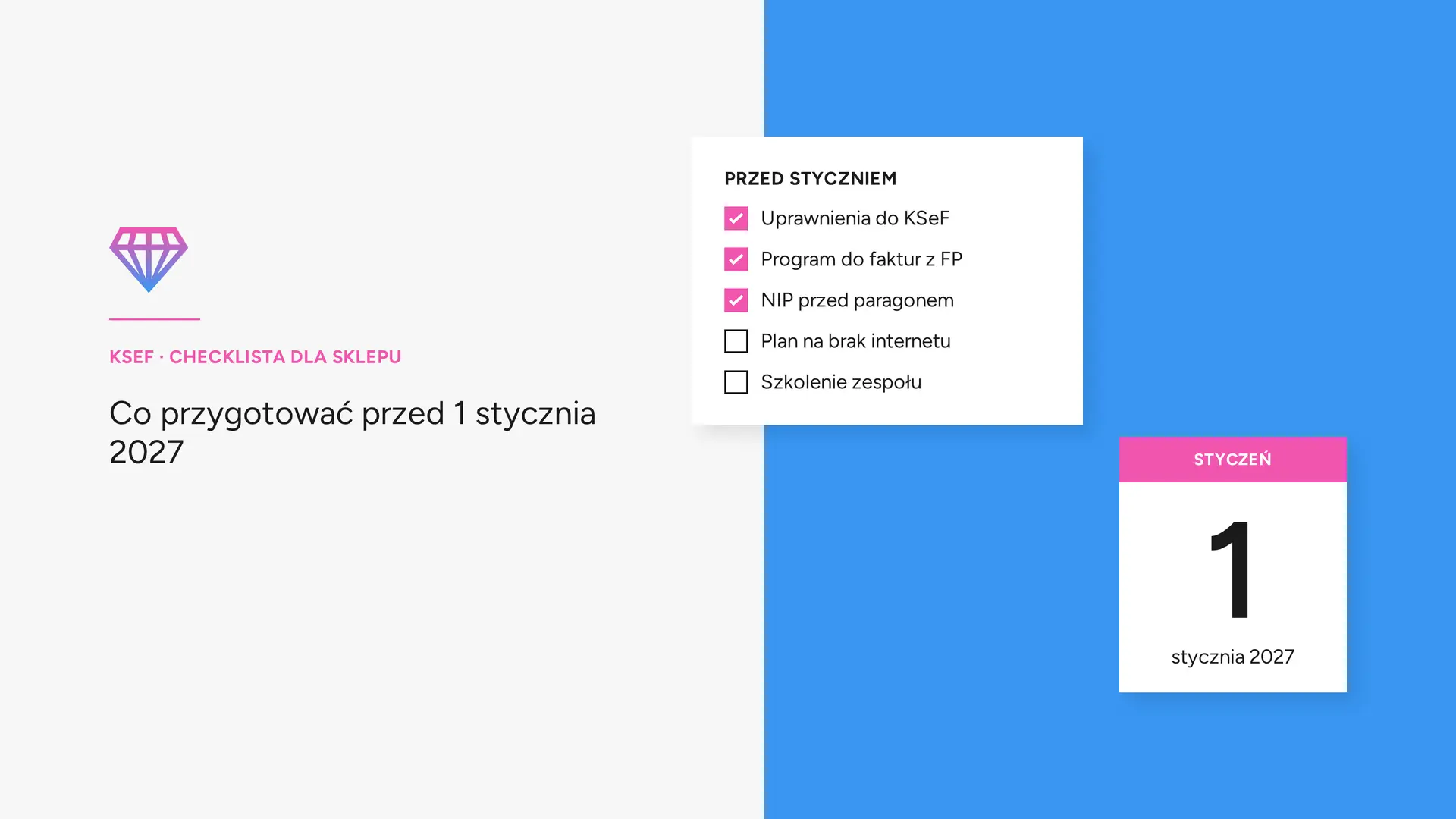
Short answer
Until 31 December 2026, a receipt with the buyer's NIP (Polish tax ID) up to PLN 450 is a simplified invoice and does not go to KSeF, Poland's National e-Invoicing System. From 1 January 2027, a receipt with NIP is no longer an invoice, whatever the amount. The cash register will still print it, but for a sale to a business that is subject to invoicing, the proper invoice is, as a rule, issued in KSeF — even for a PLN 20 purchase. Cash registers can no longer issue invoices.
In many shops, serving a business customer has looked the same for years: "with NIP?", ten digits, receipt, done. From January, this habit is no longer enough. Below we explain exactly what changes, how a sale at the till can work and what to prepare this year.
The basics — the PLN 450 limit, simplified invoices, receipts above the limit — are covered in Receipt with NIP in Poland: the PLN 450 limit.
What changes on 1 January 2027
KSeF has been mandatory since 1 February 2026 for the largest businesses and since 1 April 2026 for most other taxpayers. Until the end of 2026, however, there is a transitional exemption for taxpayers whose total sales documented with invoices subject to mandatory KSeF do not exceed PLN 10,000 gross per month. On top of that, cash registers have a transition period (Art. 145n of the Polish VAT Act).
On 1 January 2027, three exceptions end:
| What | Until 31.12.2026 | From 1.01.2027 |
|---|---|---|
| Receipt with NIP up to PLN 450 | simplified invoice, outside KSeF | only a fiscal document, not an invoice |
| Invoice issued on a cash register | allowed, outside KSeF | not allowed |
| PLN 10,000 gross monthly limit for invoices outside KSeF | applies | no longer applies |
What does not change:
- Receipts with NIP still exist. The cash register will still print the buyer's NIP on the receipt.
- Simplified invoices for domestic B2B sales still exist — from 2027 they can be issued in KSeF. In the FA(3) structure they are marked
UPR, and the buyer's NIP may be enough as buyer data. Note: the free KSeF Taxpayer Application (Aplikacja Podatnika KSeF) cannot issue simplified invoices — you need invoicing software. - Invoices for private individuals do not have to go to KSeF. They can be issued on paper or as PDF, as before.
- Invoicing deadlines. KSeF does not require the invoice to be issued immediately at the till — the general deadlines of the VAT Act apply (for a sale to a business, as a rule by the 15th day of the following month).
How a B2B sale at the till can work from 2027
If a shop registers a sale to a business on the cash register, the process has three steps:
- NIP before closing the sale. The cashier asks about an invoice before closing the receipt. An invoice to a business may not be issued later for a receipt without a NIP (Art. 106b(5) of the VAT Act).
- Receipt with NIP. The fiscal printer prints the receipt — a fiscal document, not an invoice.
- Invoice in KSeF. The shop issues an invoice for the sale registered on the cash register and sends it to KSeF. The invoice is recorded with the FP marker, and the seller must keep the link between the invoice and the receipt — including the document number and the cash register's unique number. The shop can do this automatically right after the sale, but KSeF does not change the statutory invoicing deadlines.
We describe issuing such an invoice — deadlines, data, JPK markers — in Invoice for a receipt in KSeF, step by step.
Does a sale to a business have to go through the cash register? Not always. The obligation to register sales on a cash register generally applies to sales to private individuals and flat-rate farmers. A sale to a business can, as a rule, be documented directly with an invoice in KSeF, without a receipt. In practice, the buyer's status should be established before the sale is completed — e.g. the customer says it is a business purchase and provides the NIP and the details needed for the invoice.
What if there is no internet at the till
No internet at the till does not have to block invoicing. KSeF provides, among others, the offline24 mode, in which the invoice is issued outside the system and sent to KSeF no later than the next business day. Separate rules apply when KSeF is unavailable, has a failure or a total failure.
In the standard offline24 mode, a domestic buyer with a NIP receives the invoice through KSeF. If the KSeF number has not yet been assigned, the seller can give a transaction confirmation with QR codes. The customer gets the receipt immediately, as before.
Checklist: what to prepare before 1 January 2027
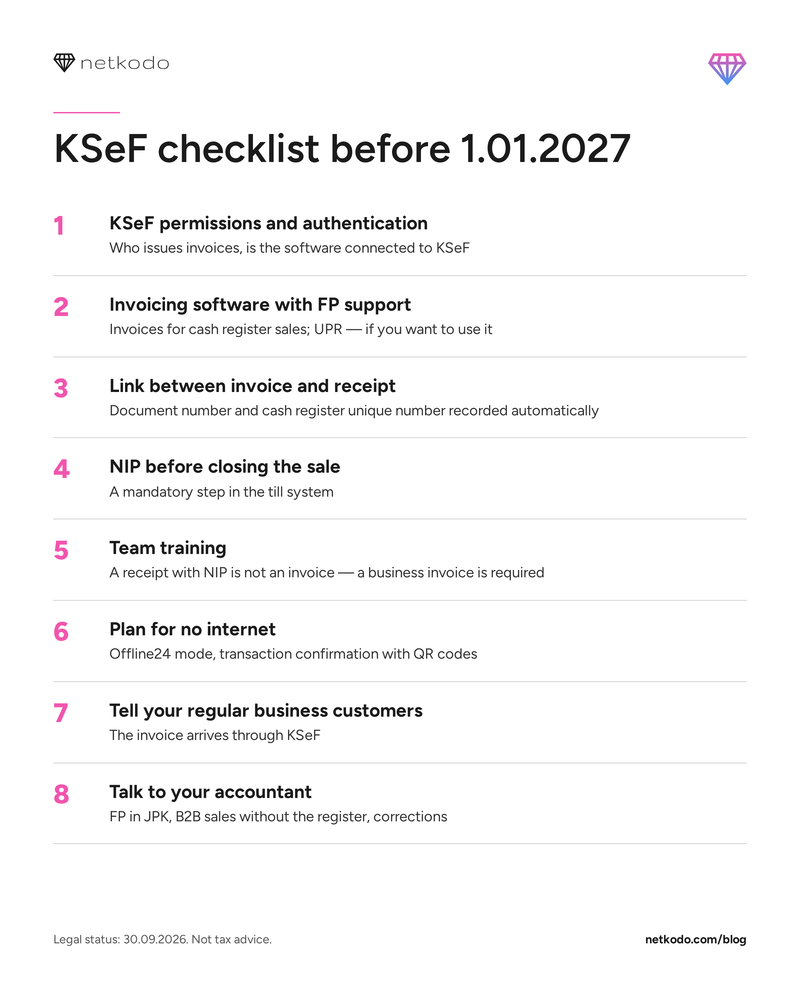
- KSeF permissions and authentication. Check who in the company has the right permissions and whether the invoicing software is properly connected to KSeF. The Ministry of Finance has announced that tokens will remain after 2026; KSeF certificates are the alternative.
- Invoicing software integrated with KSeF. It should correctly handle invoices issued for sales registered on the cash register (FP). If the shop wants to use simplified invoices, also check support for the UPR type.
- Connecting the cash register with the software. Check whether the system automatically records the link between the invoice, the receipt number and the cash register's unique number. Retyping for every business sale means queues and errors.
- Order of steps at the till. Ask "do you need an invoice?" before the cashier closes the receipt — ideally as a mandatory step in the sales system.
- Team training. Cashiers need to know that from January a "receipt with NIP" is not an invoice, and that for a sale to a business an invoice is required.
- A plan for no internet. Who issues invoices in offline24 mode and how the customer gets the transaction confirmation.
- Information for regular business customers. From January the invoice arrives through KSeF, not as a receipt with NIP handed over at the till.
- A conversation with your accountant. FP markers in JPK, possible B2B sales without the cash register, corrections.
The result? A shop that does this in November will not spend the first week of January explaining to customers at the till why "a receipt with NIP is no longer enough".
Penalties for KSeF errors are due to apply from 2027. In September 2026 the Ministry of Finance announced it would postpone them to 1 January 2028, but as of 30 September 2026 the change has not yet been enacted. The obligation to issue invoices in KSeF from 2027 remains unchanged.
Let's talk about how your shop will issue invoices from January
Book 20 minutesHow it works in Shopify POS with Netkodo Fiscal Gateway
In shops using Shopify POS, the whole process happens on the iPad. Netkodo Fiscal Gateway connects Shopify POS to a Posnet, Novitus or Elzab fiscal printer and creates the invoice in Fakturownia, wFirma or inFakt:
- The sales assistant enters the NIP in Shopify POS before closing the sale.
- Fiscal Gateway prints the receipt with NIP.
- The invoice is created in the integrated invoicing software, linked to the sale and — once the KSeF integration is configured — sent to KSeF.
No back-office computer and no retyping of data.
See how Fiscal Gateway works →
FAQ
Is a receipt with NIP still valid from 2027?
Yes, as a fiscal document. It is not an invoice, though, so it does not replace an invoice for a business.
From 2027, does every invoice for a business have to be issued in KSeF?
As a rule, yes, even for small amounts. Exceptions cover, among others, certain transactions with foreign entities. Invoices for private individuals do not have to go to KSeF.
Does the invoice have to be issued immediately at the till?
No. KSeF does not change the statutory invoicing deadlines. Issuing it automatically right after the sale is convenient, but not required.
Can a cash register issue an invoice in 2027?
No. From 1 January 2027, invoices are not issued on cash registers. The register is for receipts, and the invoice is created in KSeF.
Do simplified invoices disappear in 2027?
No. Only the receipt with NIP as a simplified invoice goes away. A simplified invoice up to PLN 450 for domestic B2B sales can be issued in KSeF marked UPR. It is optional, though — a small sale can be documented with a regular invoice.
Can I sell to a business without a receipt, straight on an invoice?
As a rule, yes, because the cash register obligation applies to sales to private individuals and flat-rate farmers. The buyer's status should be established before the sale is completed — the customer says it is a business purchase and provides the NIP and invoice details.
What if there is no internet at the till?
You can issue the invoice in offline24 mode and send it to KSeF no later than the next business day. The business customer will receive it through KSeF, and before the invoice gets a KSeF number you can give them a transaction confirmation with QR codes. Separate rules apply when KSeF is unavailable or fails.
How will a business customer receive the invoice?
Through KSeF — they download it themselves or through their accounting software. Once the invoice has a KSeF number, you can also give the customer its visualisation — e.g. a PDF or printout — with a QR code and the KSeF number.
Do KSeF penalties apply from 2027?
Under current law, yes. The Ministry of Finance has announced a postponement to 2028, but as of 30 September 2026 the change has not been enacted.
This article is for information only and is not tax advice. Legal status as of 30 September 2026. Basis: Polish VAT Act of 11 March 2004 (consolidated text: Journal of Laws 2026, item 1263), Ministry of Finance KSeF materials (ksef.podatki.gov.pl). For your specific situation, consult an accountant or tax adviser.
Any questions?
We help Polish shops sell on Shopify and Shopify POS in line with Polish regulations — from fiscal printers to KSeF.




