Shopify POS and Fiscalisation in BELLER’s Jewellery Boutique: A Deployment That Connects Online and Offline Sales
How we launched a modern point of sale in Warsaw in two to three hours.
In jewellery retail, the product is not the only thing that matters. The entire moment matters: the conversation with the customer, the way jewellery is presented, confidence in the service, and a smooth purchase journey. Technology should not distract from these elements. It should work quietly in the background - quickly, intuitively, and without creating additional barriers between the sales advisor and the customer.
That was the premise of our work with BELLER, a jewellery brand with two retail locations: Warsaw and Kraków. The client was already using a Shopify store, but its previous approach to POS had not met expectations. The main issues were an unintuitive, outdated interface, the system’s speed, and omnichannel capabilities. The goal was not to introduce technology for its own sake. It was to create a convenient sales station that would make use of Shopify’s potential, comply with Polish fiscalisation requirements, and allow the team to focus on what matters most: the customer relationship.
This article shows the journey from preparing data and processes, through the Warsaw boutique installation, to staff training, label-printer configuration, and post-launch support.
The starting point: the online store was ready, but in-store sales needed a better tool
Omnichannel commerce is not simply about being present in multiple channels. Its value appears when those channels use the same data and support one consistent sales process. BELLER already had a Shopify store, providing a strong foundation for online and in-store sales to operate from a shared product catalogue, inventory levels, and customer database.
However, the existing POS solution did not meet the standard expected by the team. In premium boutique retail, staff should not have to struggle with the screen or wait for basic actions to complete. The interface must be understandable from the first interaction, and the journey from selecting a product to payment and receipt issuance should feel like a natural part of the customer conversation.
Shopify POS was the logical direction: it connects in-store sales to the store ecosystem, lets staff work with familiar data, and provides a modern iPad experience. One key element of Polish retail remained, however: fiscalisation. This was addressed by Netkodo Fiscal Gateway, a solution that connects Shopify POS with a fiscal printer.
Data and processes first, devices second
Connecting an iPad, fiscal printer, or label printer is the most visible part of a deployment. In practice, though, the work completed before the on-site visit often determines whether the project succeeds. Even the best interface will not help if the product catalogue is incomplete, SKU identifiers are missing, or inventory levels do not reflect reality.
For this reason, the first stage was to understand the product and warehouse structure. Together with the client, we reviewed the catalogue, completed missing information - including SKU numbers - and added products available only offline. We also checked quantities and prepared warehouse configuration so sales would be assigned correctly.
At the same time, we agreed on the sales flow. This is important because a POS system should reflect how the team really works, rather than force the team into an arbitrary workflow imposed by a tool. During preparation, we considered, among other things, cases where part of an order is paid at collection and the need to handle special discounts. As a result, the installation stage could focus on final settings and testing rather than resolving basic data gaps.
This stage illustrates that a POS deployment is an operational project, not merely a technical one. Product data, inventory logic, payment flow, and the team’s everyday habits are connected. When these are organised, technology becomes support. When they are not, even a new system can only reveal existing problems faster.
The Warsaw deployment: one sales station, several components, one goal
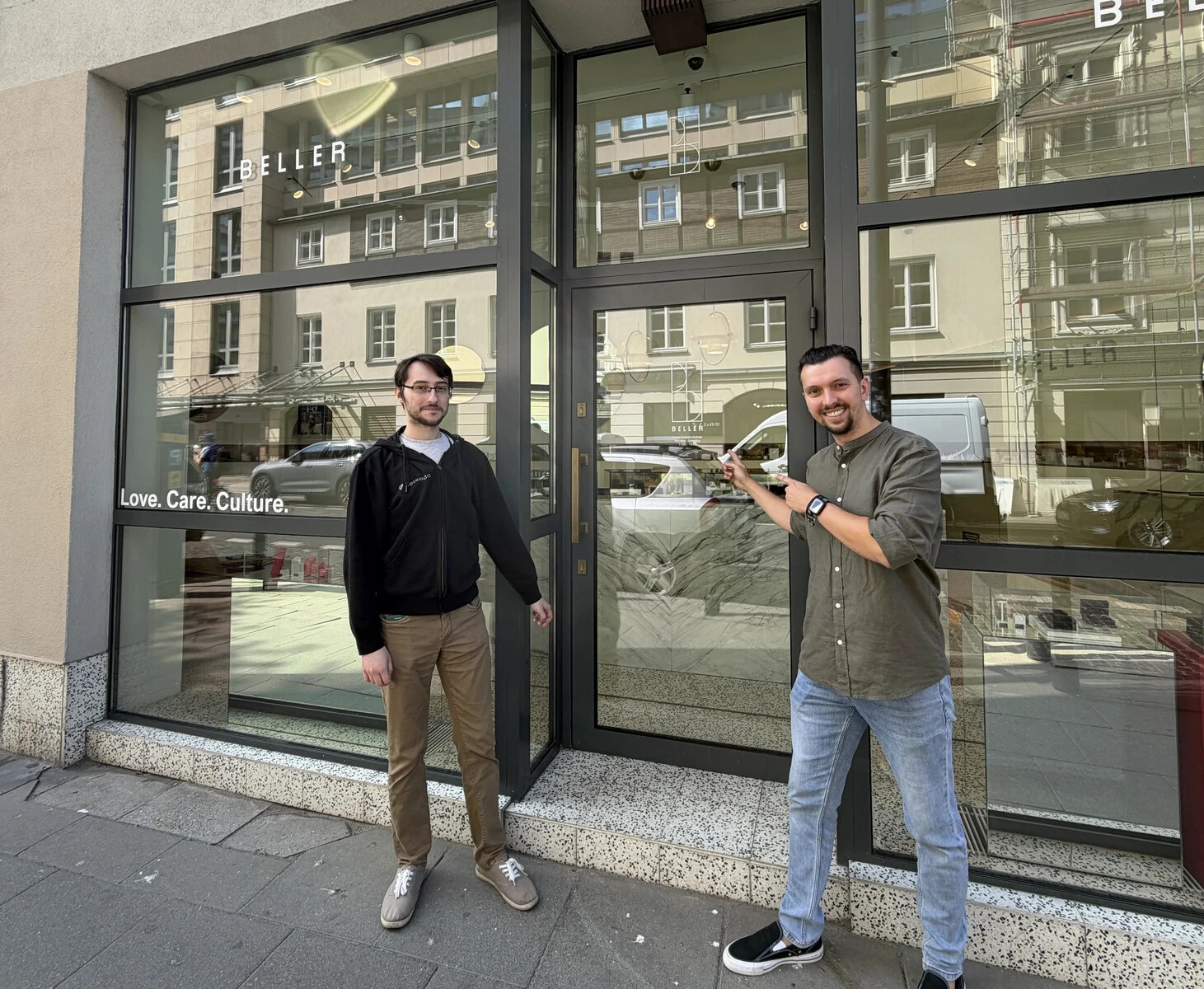
The first installation took place at BELLER’s Warsaw location. The whole process - including configuration, testing, a short training session, team questions, and a coffee break - took around two to three hours. This pace was possible thanks to the earlier preparation of the catalogue, inventory, and sales process.
The scope covered connecting and configuring every key part of the sales station:
- an iPad with the Shopify POS app;
- Netkodo Fiscal Gateway, responsible for connecting the sales process with fiscalisation;
- TP-Link devices using Powerline technology;
- a Posnet Temo Online fiscal printer;
- a Zebra ZD421 label printer.
On the iPad, we installed and authorised Shopify POS, then tailored the Smart Grid to the team’s needs. Smart Grid makes it easy to place the most frequently used functions and shortcuts on screen, which has a real effect on daily operations. Instead of searching through menus, staff have the right actions at hand in a layout that matches the actual flow of their work.
In a fiscal system, simply turning devices on is not enough. We tested the entire chain - from creating an order to printing a receipt - to ensure that the solution would work in real conditions.
Fiscalisation with Shopify POS: a solution that does not complicate service
One of the most important parts of the deployment was configuring and validating the Posnet Temo Online fiscal printer. As part of this implementation, we extended the catalogue of devices supported by Netkodo Fiscal Gateway to include this model and configured the required character limit for receipt printing. This is another step in developing the solution around the real needs of Polish retailers using Shopify POS.
In practice, fiscalisation should be predictable. A staff member should not have to consider how to connect a sale with a receipt technically, or carry out extra manual actions that lengthen the queue and increase the chance of error. After configuration, we tested order creation and receipt printing to confirm that the complete scenario worked correctly.
The result is a sales station in which Shopify POS provides a smooth user experience while Netkodo Fiscal Gateway handles the required fiscal process discreetly. For the sales team, what matters most is that technology supports customer service instead of becoming its central focus.
Stable connectivity without opening walls: the role of Powerline technology
Not every sales station is located beside the router. In a physical boutique, bringing an internet connection to a particular location can mean extra cabling, disruption to walls or flooring, and interference with the look of the interior.
For BELLER, we used TP-Link devices based on Powerline technology. The solution provided connectivity for the devices without requiring a new cable installation. This made it possible to optimise the internet connection for the sales station while preserving the order and character of the space.
A good deployment is more than handing over a working system. We look for practical solutions in the actual environment, supporting partners with configuration, equipment selection, and unobtrusive network infrastructure.
Zebra ZD421 labels: an additional area that improves everyday work
The project also included connecting and configuring a Zebra ZD421 label printer. We prepared label templates and trained the team to use them. This area often formally remains on the client side, but in practice it has a significant effect on working comfort and the consistency of product-related processes.
That is why we chose to support BELLER in this area too. The objective was not simply to complete a POS installation and tick off the items on a list. We wanted the new set of tools to be useful from day one and to account for the tasks staff carry out every day.
This case also shows why a good deployment requires a view beyond the core scope. In-store retail is an ecosystem: a product needs to be found in the catalogue, paid for, fiscalised, and sometimes labelled or prepared for collection.
A strong first impression: a “WOW” effect instead of a long adjustment period
After launch, the client’s response was especially telling. The “WOW” effect appeared in the first minutes of use. Automatically available product collections, connection to the existing customer database, and the fluid Shopify POS interface quickly demonstrated the advantage of the new solution over the system previously tested.
This is an important signal in technology projects. Success is not measured by the number of configured devices or the length of the documentation. It becomes visible when a user immediately understands the tool, can perform their work efficiently, and sees that the system removes previous obstacles. For BELLER, the combination of a modern interface, shared data, and integrated fiscalisation created exactly that experience.
The deployment also opened the way for further development. One possible next step is adding the ability to mark an order as fulfilled in the Shopify POS interface - an action that was not previously available directly in the POS app. This is particularly valuable to us because developing features from real client scenarios is the best way to create tools that genuinely solve problems.
A second deployment delivered remotely: usability proven in practice
While the physical installation was completed in Warsaw, BELLER also operates a location in Kraków. Because the solution and its configuration are intuitive, the client was able to prepare the launch at the second location independently with our remote support.
This is an important outcome of the project. Scaling in-store sales should not mean starting from scratch at every additional boutique. Well-prepared data, a clearly defined process, and a simple-to-use system allow a proven model to be transferred to new locations. The implementation partner’s role does not end with a one-off installation; it is about giving the client greater independence and confidence as their retail network grows.
Deployment is the beginning, not the final point of the project
Launching a system is an important milestone, but we do not treat it as the end of our collaboration. Retail brings new situations: processes change, new devices appear, team expectations grow, and customers need additional service scenarios. That is why we remain available to our partners after launch.
We continue to develop Netkodo Fiscal Gateway, add support for further devices and use cases, and help even when a question does not concern our product alone. This approach lets us build solutions together with the businesses that use them - as they grow, add locations, and develop new needs.
In BELLER’s case, it is particularly satisfying that the deployment brought together three perspectives: a premium brand’s expectations of service quality, the operational needs of in-store retail, and Polish fiscalisation requirements. Shopify POS, Netkodo Fiscal Gateway, Posnet Temo Online, an iPad, and appropriately configured network equipment became one coherent sales station.
Key takeaways from the BELLER project
The BELLER story shows that a modern POS can be simple for users while being ready for more complex operational requirements. To achieve this, it is worth keeping a few principles in mind.
First, begin a deployment with data and the sales process - not with devices. A structured catalogue, correct SKUs, reliable inventory levels, and agreed payment scenarios are the foundation of a smooth start. Second, technology in the boutique should suit the space, including when that means solving an internet-connectivity issue without adding cables. Third, fiscalisation must be part of a seamless workflow, not a separate and problematic service stage. Finally, view the system as a whole by including labels, team training, and future feature development.
For our new partner, this meant moving from an unintuitive solution to a sales station that uses the existing Shopify ecosystem, provides efficient fiscalisation, and gives the team a convenient tool for everyday work. For us, it is further proof that Shopify POS can effectively support Polish physical retailers - even where the highest standards of service and customer-experience detail matter.




