
5 Hidden Truths About Using ChatGPT with Shopify in AI-commerce
This article outlines the strategic shift from traditional e-commerce to Agentic Commerce using ChatGPT and Shopify.
It explains why merchants must move beyond basic chatbots to optimize for Generative Engine Optimization (GEO), separate sales AI from support AI, and prepare for a future where autonomous agents are the primary buyers.
Key information at a glance
- Integrating ChatGPT with Shopify signals a shift toward the Agentic Commerce Protocol (ACP): a new framework that connects data, payments, and AI agents.
- You must optimize product data for AI (Semantic Product Optimization), not just keyword matching.
- The best way to train a reliable AI is to first gather real conversation datasets via Shopify Inbox.
- One model cannot handle both discovery and order queries simultaneously. You need specialized architectures.
- We are moving toward a pay-per-sale model where AI agents autonomously purchase on behalf of humans.
Why is it important?
The hype around integrating AI tools like ChatGPT with Shopify is justified, but most merchants are missing the bigger picture. We are witnessing a structural shift in how people buy. The chat window is becoming the new storefront.
This shift is driven by Conversational Commerce and the Agentic Commerce Protocol (ACP). It’s a transition that requires a fundamental rethink of your store's data and strategy.
Here are the 5 uncomfortable truths that will redefine visibility, control, and customer loyalty for Shopify merchants.
Truth 1: Your New SEO is Speaking AI (GEO/SPO)
Forget keyword stuffing. In the era of LLMs, you need to master Generative Engine Optimization (GEO), also known as Semantic Product Optimization (SPO).
What is GEO?
The goal is no longer matching a user's search query string. The goal is to help an AI model truly understand your product: what it is, why it matters, and the context in which it is relevant.
If the AI doesn't understand your product's purpose, it won't recommend it.
Comparison: SEO vs. GEO
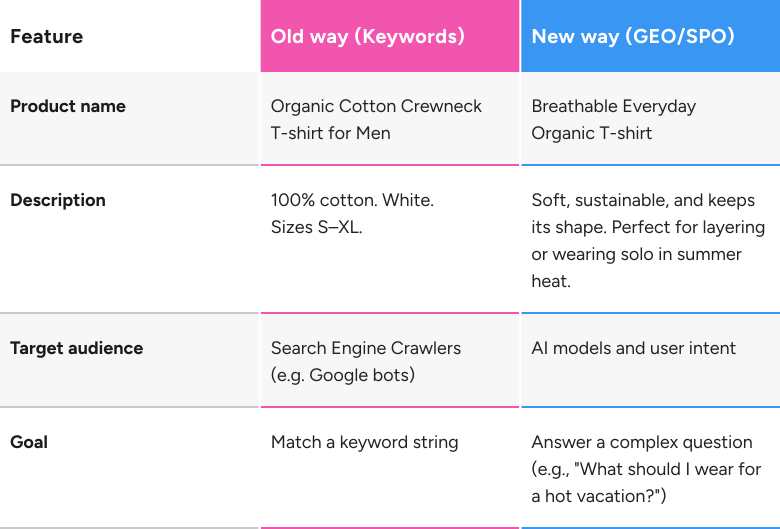
Why this works: The second version anticipates intent (warm days, layering) and provides real-world context. AI agents look for this semantic richness to answer complex user queries, such as "find me a durable t-shirt for a summer vacation."
Truth 2: The Smartest First Step with AI is… Manual
Here is a paradox: the most effective way to launch your AI strategy is to, at first, not use AI at all.
Start with Shopify Inbox
Instead of buying an expensive, uncalibrated chatbot, install Shopify Inbox and answer customer queries manually for 4–6 weeks.
Build Your Training Corpus
By doing this, you build a proprietary dataset that no competitor has:
- What specific questions do your customers ask?
- What information is missing from your product pages?
- Which frustrations are repeated?
This log becomes the ground-truth training data for your future AI. The model is only as good as the training data you feed it.
As one successful Shopify merchant noted: "We moved common questions into self-service answers that now resolve 90% of chats. When we find a chatbot that feels human enough, we’ll train it on this data."
Truth 3: Your Sales AI Can’t Be Your Support AI
A common mistake: assuming a single LLM can handle the entire customer journey.
It cannot.
The Architecture of AI Commerce
You need distinct specialized models:
- Sales AI: Handles discovery, recommendations, and customer intent. It needs creativity and persuasive language.
- Support AI: Manages post-purchase anxiety. It needs rigid adherence to facts, real-time access to Shopify refund logic, and order tracking.
Why Generic Models Fail
A generic ChatGPT integration often fails at simple transactional queries (such as: ”Where is my order?”) because it lacks a real-time, deep connection to your logistics data.
If you try to force one bot to do both, you risk hallucinations in support (promising refunds you can't give) or robotic, uninspiring responses in sales.
Truth 4: You’re Giving Up Control of Your Storefront And That’s Okay
Traditional e-commerce gave you control over every pixel of the landing page. Agentic commerce follows the Agentic Commerce Protocol (ACP), where the interface is fluid.
The Shift to Pay-Per-Sale
When a user asks ChatGPT for a sustainable skincare set, the AI decides which brands appear and how they are compared. The customer interacts and buys directly within the AI interface, often bypassing your visual storefront entirely.
This is scary, but it shifts the economics. Instead of paying per click (CPC) with no guarantee of a sale, the model moves toward pay-per-sale: a predictable, lower-risk expense. You lose (partially) narrative control, but you gain financial clarity and access to new markets.
Truth 5: The Future Isn’t Chatbots, It’s Autonomous Shopping Agents
ChatGPT x Shopify is just Phase One. The real revolution is Agentic Commerce: AI agents that buy on behalf of humans.
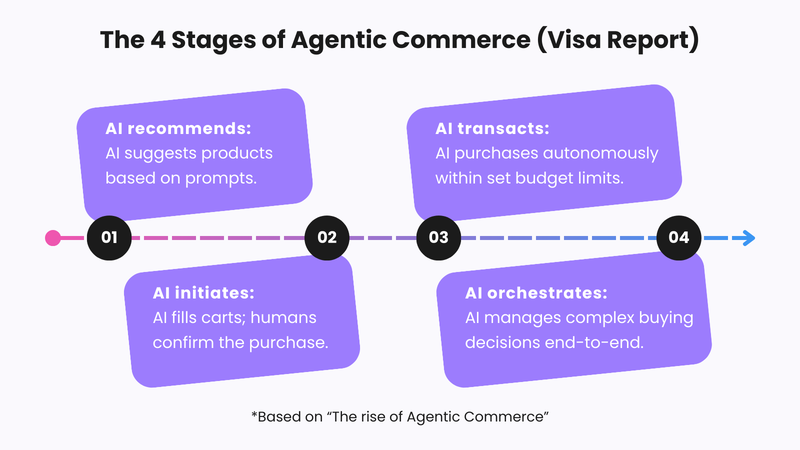
The 4 Stages of Agentic Commerce (Visa Report)
- AI recommends: AI suggests products based on prompts.
- AI initiates: AI fills carts; humans confirm the purchase.
- AI transacts: AI purchases autonomously within set budget limits.
- AI orchestrates: AI manages complex buying decisions end-to-end.
You can find the full report here: The rise of Agentic Commerce
We are currently entering stage two. Soon, your customers will be rational software agents making data-driven decisions. Merchants who optimize their data for these agents (via GEO/SPO) will thrive; those relying solely on visual ads will become invisible.
Merchant Action Plan: Your GEO Readiness Checklist
Use this roadmap to prepare your store for Agentic Commerce without breaking your budget.
- Week 1: Install Shopify Inbox (keep AI automation off).
- Week 2–5: Manually answer customer queries to gather real intent data.
- Week 6: Audit chat logs to tag repeated questions and missing context on product pages.
- Week 7: Rewrite your top 10 product descriptions using the GEO format (Context + use case).
- Week 8: Activate a basic support bot trained only on your verified answers.
When you are ready to start building the technology, read our practical step-by-step implementation guide next. It covers specific plugins, setup instructions, and technical workflows: ChatGPT in Shopify: How to Use AI in Your E-commerce Store
FAQ: Frequently Asked Questions About Using AI & ChatGPT with Shopify
What is GEO for Shopify product pages?
GEO (Generative Engine Optimization) involves structuring product data with semantic richness (context, benefits, and use cases) so AI models can understand and recommend your products in natural language conversations. Unlike SEO, which targets keywords, GEO targets understanding.
How is GEO different from traditional SEO?
Traditional SEO focuses on ranking links for specific keywords (e.g., "red men's shirt") to drive clicks. GEO focuses on being the direct answer an AI gives to a complex user intent (e.g., "Find me a durable shirt for a summer hiking trip"). SEO optimizes for search engines; GEO optimizes for Large Language Models (LLMs).
What is the Agentic Commerce Protocol (ACP)?
ACP is an emerging open standard that standardizes how AI agents discover products, negotiate prices, and execute payments without human intervention.
How does Agentic Commerce change my marketing strategy?
It shifts focus from visual disruption (ads, banners) to data integrity. You must ensure your product feeds are accurate and rich so buyer agents can find and validate your stock. If an AI agent cannot read your data, you are invisible.
Will my brand identity disappear in the Agentic Commerce era?
No, but its role will shift. As the visual storefront becomes less critical for discovery, your brand identity must live in your "Voice of Customer" data, your unboxing experience, and the post-purchase relationship. Your brand becomes what the AI says about you, not just what your website looks like.
How do I get started with AI on a small budget?
Start with Shopify Inbox to manually tag and categorize customer questions. This costs nothing and builds the essential dataset you will need to train an automated agent later. Do not buy a bot until you have the data to teach it.
Is it safe to connect ChatGPT to my Shopify customer data?
Yes, but only if you use enterprise-grade integrations or established Shopify Apps that respect data privacy standards (GDPR/CCPA). Never paste sensitive customer CSVs directly into public ChatGPT prompts. Always use an app that anonymizes data via API.
Why is my ChatGPT store integration giving incorrect order information?
This usually happens because the AI lacks real-time API access to your Shopify Orders database. Ensure your solution uses RAG (Retrieval-Augmented Generation) to pull live data before answering.
Does implementing GEO require coding skills?
Not necessarily. While an advanced semantic schema requires code, you can start by rewriting your product descriptions to be more conversational and context-rich. Think of it as writing for a helpful sales assistant rather than a keyword crawler.
Should I use one AI tool for marketing and support?
Generally, no. Marketing AI requires creativity and persuasion, while Support AI requires strict accuracy and real-time database access. Using specialized tools for each yields better results and reduces the risk of incorrect refund promises.
Can I replace my entire support team with AI?
No. AI is best for Tier 1 support (FAQs, order status, simple returns). You still need humans for complex issues, empathy-driven conflict resolution, and high-value VIP interactions.
How do I separate Sales AI from Support AI in Shopify specifically?
Use distinct entry points. For example, a Product Concierge bot on collection pages (Sales AI) can be prompted to be enthusiastic and suggestive. A separate Order Status bot on the tracking page (Support AI) should be prompted to be concise, factual, and apologetic when delays occur.




